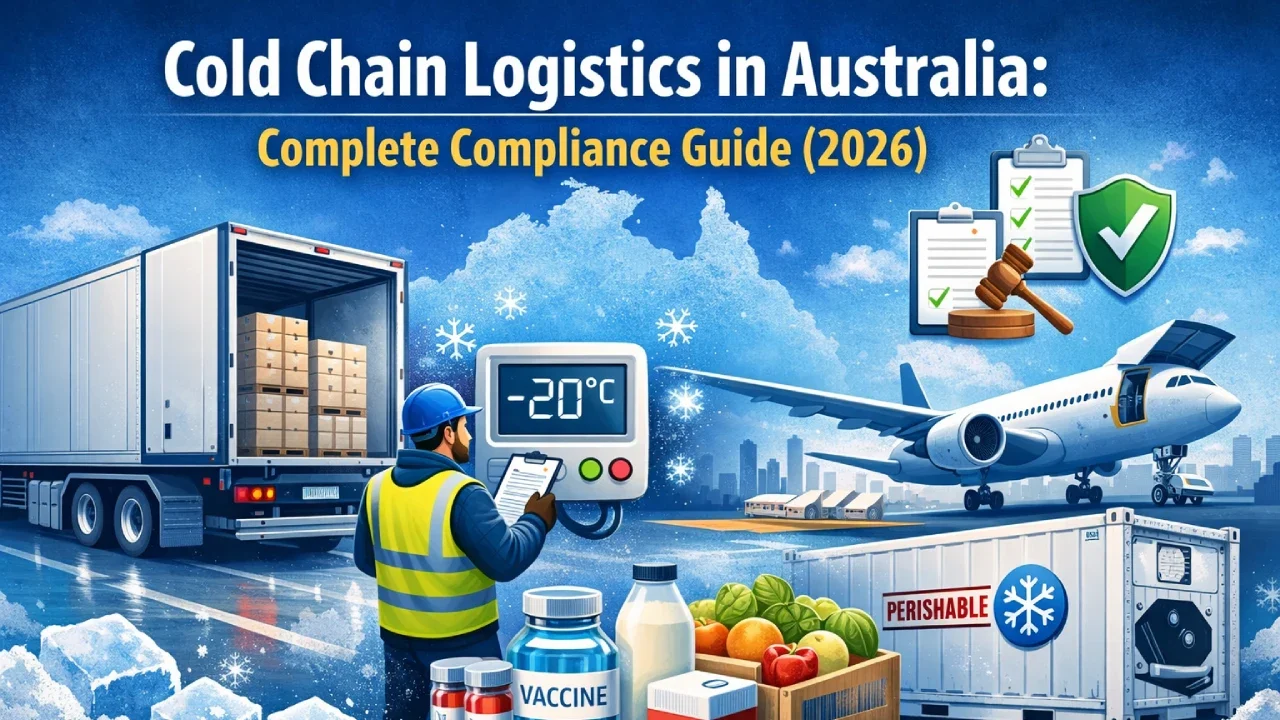
A refrigerated truck pulls into a Sydney distribution centre. The paperwork looks fine. The goods look fine. But somewhere between the manufacturer's cool room and this loading dock, the temperature crept above the permitted range for four hours — and nobody logged it.
That's a cold chain failure. And depending on what's inside — infant formula, insulin, raw chicken, vaccine doses — it can mean spoiled product worth thousands, a costly recall, regulatory penalties, and potentially a serious risk to consumer health.
Cold chain logistics is one of the most technically demanding areas of freight in Australia. The stakes are high, the regulations are strict, and the margin for error is essentially zero. This guide explains everything Australian businesses need to know about cold chain logistics compliance in 2026 — from temperature requirements to choosing a provider that will never put your product, your customers, or your licence at risk.
- Cold chain logistics maintains a controlled temperature environment for perishable goods from origin to destination.
- Australian cold chain is governed by FSANZ food standards, TGA pharmaceutical guidelines, and state food authority requirements.
- Temperature excursions — even brief ones — can render an entire shipment non-compliant and unsaleable.
- Key industries: food & beverage, pharmaceutical, healthcare, agriculture, and cosmetics.
- Aussie Trident Group provides refrigerated linehaul services from Sydney interstate with continuous temperature monitoring and full compliance documentation.
What Is Cold Chain Logistics?
Cold chain logistics refers to the end-to-end management of temperature-sensitive goods through every stage of the supply chain — from manufacturing or harvest, through storage, transport, and distribution, all the way to the end consumer or point of care.
The "chain" in cold chain is critical: every link matters. A product might be stored perfectly at the manufacturer's facility, transported flawlessly, and then sit on an unrefrigerated loading dock for 45 minutes while paperwork is processed. That gap — that single broken link — can compromise the entire consignment.
Effective cold chain logistics requires:
- Temperature-controlled storage at every node (manufacturer, 3PL warehouse, distribution centre, retail or end-point)
- Refrigerated or insulated transport vehicles with continuous monitoring
- Trained staff who understand handling protocols and the consequences of excursions
- Real-time data logging and documentation to prove compliance at every stage
- Clear escalation procedures when temperature thresholds are breached
Australian Cold Chain Temperature Requirements by Product Type
Different products require different temperature zones. Understanding these ranges is the foundation of cold chain compliance — and the starting point for any conversation with a logistics provider.
❄️ Frozen Goods
Ice cream, frozen meat, seafood, ready meals, frozen vegetables. Any excursion above −15°C triggers a quality review under Australian Cold Chain Guidelines.
🧊 Chilled / Fresh
Fresh meat, dairy, smallgoods, cut produce, ready-to-eat foods. FSANZ Standard 3.2.2 requires chilled food be stored at or below 5°C at all times during transport.
💊 Pharmaceutical / Healthcare
Vaccines, biologics, insulin, blood products, certain diagnostics. TGA regulations and GDP guidelines require documented proof of continuous compliance.
🌡️ Controlled Ambient
Some medications, cosmetics, nutraceuticals, and wine. Often underestimated — Australian summers can see vehicles exceed 40°C internally without temperature control.
Under FSANZ food safety standards, potentially hazardous food that has been in the temperature danger zone (5°C to 60°C) for more than 4 hours cumulative must be discarded. Food between 2–4 hours must be used immediately and not refrigerated again. Many transport and loading operations don't account for cumulative time — this is one of the most common causes of compliance failures.
Australian Cold Chain Regulatory Framework: What Governs Compliance?
Cold chain logistics in Australia sits at the intersection of several regulatory frameworks. Understanding which apply to your product is essential — and your logistics provider should know these inside out.
Food Standards Australia New Zealand (FSANZ)
The Australia New Zealand Food Standards Code sets legally binding requirements for the handling, storage, and transport of food products. Standard 3.2.2 (Food Safety Practices and General Requirements) and Standard 3.2.3 (Food Premises and Equipment) are most directly relevant to cold chain transport. Businesses operating as food businesses must comply — and can be audited by state food authorities at any time.
Therapeutic Goods Administration (TGA)
Pharmaceutical products — prescription medicines, vaccines, biologics, and regulated complementary medicines — fall under TGA jurisdiction. The TGA's Good Distribution Practice (GDP) guidelines require documented cold chain management, temperature monitoring throughout transit, and qualified personnel responsible for cold chain integrity. Non-compliance can result in licence suspension or product recall.
Australian Cold Chain Guidelines (AFGC / GS1 Australia)
The Australian Food and Grocery Council (AFGC) and GS1 Australia publish the Australian Cold Chain Guidelines — a widely adopted industry standard covering temperature management, monitoring, excursion response, and documentation for food and grocery supply chains. While not law, these guidelines are referenced by major retailers as a condition of supply.
State Food Authority Requirements
Each Australian state has its own food authority that administers food safety regulations at the state level — NSW Food Authority, Safe Food Queensland, PrimeSafe (Victoria), PIRSA (South Australia), and others. Interstate transport of food products must comply with the requirements of both the origin and destination states.
Chain of Responsibility (CoR) Laws
Under Heavy Vehicle National Law (HVNL), Chain of Responsibility laws hold all parties in the supply chain — not just drivers — responsible for transport safety. This includes consignors, schedulers, loaders, and receivers. For cold chain, this means businesses that instruct unrealistic delivery timescales or fail to provide adequate cool room access at pick-up can be held liable for compliance failures.
The Most Common Cold Chain Failures — and How to Prevent Them
Cold chain failures rarely happen because of catastrophic equipment breakdown. Most occur because of small, preventable lapses in procedure. Here are the most common failure points in Australian cold chain operations:
| Failure Point | What Goes Wrong | Prevention |
|---|---|---|
| Loading dock delays | Product sits unrefrigerated while paperwork is processed or dock space is unavailable | Pre-book dock slots; use insulated covers during staging; set maximum unrefrigerated exposure times |
| Vehicle temperature not pre-cooled | Truck or van body not brought to set-point temperature before loading — product warms quickly | Require pre-cool confirmation before every load; check data logger before accepting freight |
| No continuous monitoring | Temperature is checked at pickup and delivery only — excursions during transit go undetected | Require continuous data logging (minimum 10-minute intervals); review logs on arrival |
| Door openings during multi-drop runs | Repeated door openings on multi-stop deliveries allow warm air ingress, raising internal temperature | Use refrigeration units with blast-back recovery; limit multi-drop runs for critical product; use curtain systems |
| Incorrect stacking / airflow blocking | Freight stacked against refrigeration unit return air vents, preventing temperature distribution | Train loaders on correct stacking; mark return air zones in vehicle; conduct pre-load briefings |
| Inadequate packaging | Product not in thermally appropriate packaging — relies entirely on vehicle refrigeration | Use validated packaging for known transit times; include temperature indicators inside cartons |
| Documentation gaps | Temperature logs exist but don't cover all transit legs, or records are incomplete for audit | Implement end-to-end documentation protocol; retain all records for minimum 3 years |
| Staff training failure | New or casual staff unaware of cold chain protocols; correct procedures not followed | Mandatory cold chain induction; refresher training every 12 months; signage in loading areas |
- Product loss: The affected consignment must be condemned and disposed of — a direct financial loss.
- Product recall: If temperature-compromised product has already reached consumers, a recall may be required — costing tens to hundreds of thousands of dollars.
- Regulatory action: State food authorities and the TGA can issue improvement notices, suspend licences, or prosecute under food safety and therapeutic goods legislation.
- Retailer de-listing: Major retailers treat cold chain compliance failures as grounds for immediate de-listing, which can destroy revenue overnight.
- Reputational damage: In the age of social media, a contamination or recall event can permanently damage a brand that took years to build.
How to Choose a Compliant Cold Chain Logistics Provider in Australia
Not all refrigerated transport companies are equal — and "we have reefer trucks" is not the same as full cold chain compliance. When evaluating a cold chain logistics provider in Sydney or Australia-wide, here is what to look for:
Ask to see a sample temperature log from a recent delivery. Compliant providers log temperature at regular intervals (every 5–15 minutes) throughout transit. If they only check at pickup and delivery — walk away.
Hazard Analysis and Critical Control Points (HACCP) certification demonstrates that the provider has a documented, audited system for identifying and controlling food safety risks across their operation.
Temperature monitoring equipment must be regularly calibrated to ensure accuracy. Ask for calibration certificates for both in-vehicle sensors and any hand-held monitoring devices used at pickup and delivery.
What happens when a temperature excursion is detected mid-transit? A compliant provider has a written procedure — escalation to a supervisor, client notification within a set timeframe, and a decision protocol for whether product is condemned or held for assessment.
All drivers and handlers working with temperature-sensitive freight should have documented training in cold chain procedures. Ask to see training records or evidence of a cold chain induction programme.
Standard freight insurance often excludes temperature-related spoilage. Your provider should carry cargo insurance that explicitly covers cold chain product loss due to refrigeration failure or temperature excursion.
From job creation to delivery confirmation, every step of the cold chain should be documented and available to you on request. This documentation is your evidence of due diligence in the event of a regulatory audit or insurance claim.
A provider who claims pharmaceutical experience should be able to name pharmaceutical clients. A provider handling fresh produce should have documented experience with FSANZ Standard 3.2.2. Ask specifically — not generally.
Industries That Depend on Cold Chain Logistics in Australia
Food and Beverage
Australia's food manufacturing and distribution sector is the largest user of cold chain logistics. Fresh meat, seafood, dairy, produce, smallgoods, and convenience meals all require continuous refrigeration. With supermarket supply chains operating on tight just-in-time schedules, cold chain failures translate immediately into empty shelves — and supplier penalties.
Pharmaceutical and Healthcare
Vaccines, biologics, oncology medications, and blood products represent some of the highest-value, highest-risk cold chain freight in Australia. A single failed vaccine shipment can affect public health programmes and involve the TGA, state health departments, and the media. GDP compliance is not optional — it is mandatory for any business in the pharmaceutical supply chain.
Agriculture and Horticulture
Fresh fruit, vegetables, cut flowers, and live seafood require careful temperature and atmosphere management from farm gate to market. Cold chain failures in agriculture often affect export consignments, where rejection at the border compounds financial loss with reputational damage in overseas markets.
Cosmetics and Nutraceuticals
High-end skincare products, probiotics, certain vitamins, and natural health products are increasingly temperature-sensitive. While not always subject to the same regulatory rigour as food or pharmaceuticals, temperature excursions can degrade active ingredients, affect product efficacy, and void manufacturer warranties.
Chemical and Industrial
Certain chemicals, adhesives, resins, and industrial compounds require temperature-controlled transport to maintain stability, prevent separation, or comply with MSDS requirements. This is a less commonly discussed segment of cold chain, but a significant one for manufacturing businesses.
Interstate Cold Chain Logistics from Sydney: What You Need to Know
Moving temperature-sensitive freight interstate from Sydney adds complexity — longer transit times, more potential failure points, and multiple regulatory jurisdictions. Here's what you need to plan for:
| Route | Transit Time (Road) | Key Considerations | ATG Service |
|---|---|---|---|
| Sydney → Melbourne | 10–12 hours | Overnight linehaul common; alpine weather in winter; strict PrimeSafe requirements in VIC | ✅ Refrigerated linehaul |
| Sydney → Brisbane | 10–12 hours | High ambient temperatures in QLD; Safe Food Queensland requirements apply on arrival | ✅ Refrigerated linehaul |
| Sydney → Adelaide | 14–16 hours | Nullarbor-adjacent routing; extreme summer heat; PIRSA requirements in SA | ✅ Refrigerated linehaul |
| Sydney → Perth | 40–45 hours (road) | Longest mainland route; air freight recommended for pharmaceuticals and high-value perishables | ✅ Air freight coordination |
| Sydney → Regional NSW | 2–8 hours | Last-mile delivery to regional distributors and retailers; less infrastructure than metro | ✅ Regional refrigerated |
For all interstate cold chain movements, Aussie Trident Group provides continuous temperature logging, full documentation packages for compliance purposes, and direct account management — so you always know exactly where your freight is and what temperature it's at.
Learn more about our refrigerated linehaul services and road freight from Sydney.
How Aussie Trident Group Manages Cold Chain Compliance
At Aussie Trident Group, cold chain is not an add-on service — it's a core capability that we have developed and refined across years of handling temperature-sensitive freight for food, pharmaceutical, and healthcare clients across Australia.
Our Cold Chain Standards Include:
- Refrigerated vehicles pre-cooled to set-point temperature before every load
- Continuous temperature data logging throughout every transit leg
- Temperature logs available to clients within 24 hours of delivery
- Documented excursion response protocol — client notification within 30 minutes of any breach
- Drivers trained in cold chain procedures and HACCP principles
- Cargo insurance that explicitly covers temperature-related product loss
- Full compliance documentation for FSANZ, TGA, and state food authority requirements
- Dedicated account management — one point of contact for every cold chain movement
- Temperature certificate for every delivery — suitable for audit purposes
- Proof of delivery with timestamp and recipient signature
- Digital temperature log accessible via client portal
- Incident report and root cause analysis for any excursion event
- Annual compliance review and documentation audit support
Building a Cold Chain Compliance Plan for Your Business
If your business handles temperature-sensitive goods and doesn't yet have a documented cold chain compliance plan, here's how to build one:
- Map your product temperature requirements. Identify every product you handle, its required temperature range, and the maximum allowable time outside that range. Document this in a product temperature matrix.
- Audit your current cold chain. Walk through every stage — from your supplier's cool room to your customers' receiving dock. Identify every point where temperature control is handed over, and assess the risk at each handover.
- Define your critical control points. Based on your audit, identify the stages where a failure is most likely and most damaging. These become your HACCP critical control points — the moments that require the most rigorous monitoring and procedure.
- Choose compliant logistics partners. Evaluate every transport and warehousing provider against the eight criteria listed in this guide. Don't accept verbal assurances — request documentation.
- Implement monitoring and documentation. Set up systems to capture temperature data, store records, and make them accessible for audit. Digital systems that provide real-time alerts are best — manual logging is too dependent on individual compliance.
- Train your team. Everyone who touches temperature-sensitive product — from goods receiving staff to loading dock supervisors — needs to understand cold chain principles and your internal procedures.
- Test, review, and update. Cold chain compliance is not a set-and-forget exercise. Review your plan annually, after any excursion event, and whenever you add new products or change logistics providers.
Frequently Asked Questions: Cold Chain Logistics in Australia
Need a Trusted Cold Chain Partner in Sydney?
Aussie Trident Group provides fully compliant refrigerated logistics from Sydney to every major Australian city. Talk to our team about your temperature-sensitive freight requirements — we'll build a solution that protects your product, your customers, and your compliance record.
Explore Refrigerated Linehaul View Our 3PL Services